


Underwater photography prints bring depth, movement, and atmosphere to a room without relying on loud color or busy decoration. The right image can make a bedroom feel quieter, give a wellness space a sense of flow, or add a refined coastal accent to a hotel, office, or bathroom.
When I choose ocean wall art for a calm, low-light room, I look at three things first: how the image uses underwater light, how its colors relate to the existing palette, and how the print surface will respond to reflections.
Moss Fine Art underwater photography is printed on 3mm Aluminum DIBOND® with a direct, matte, glare-free finish. The panels are UV- and moisture-resistant, include a hanging kit, and are available from $60. Free shipping is available on purchases over $60.
How underwater light changes the mood of a print
Underwater images are shaped by the way light moves through water. As depth increases, warmer colors such as red, orange, and yellow are absorbed more quickly. Blue and green tones become more dominant. This is why deeper underwater photography often feels cooler, quieter, and more atmospheric than a shallow-water image.
Light direction matters as well. A photograph with open water, surface light, or soft illumination from above can feel spacious and airy. An image built around deep shadows, rock, roots, or dense marine life will usually feel more dramatic and grounded.
For a low-light room, neither approach is automatically better. The choice depends on the mood you want:
- Soft blue and teal imagery can make a room feel open and restful.
- Deep shadows and darker water can add intimacy and visual weight.
- Bright highlights help an image remain readable when the surrounding lighting is subdued.
- Simple compositions are easier to live with in bedrooms, reading areas, and wellness spaces.
The best underwater photography prints do not need to show an obvious horizon or a recognizable coastline. Texture, depth, and movement can communicate the ocean just as effectively.
Choose texture when you want quiet visual structure
Underwater Eroded Limestone Texture Aluminum Print by Robert Moss – Ocean Conservation Art was photographed in Mexico. It focuses on deep shadows and natural patterns in underwater limestone rather than a single animal or large scene.

This type of ocean photography wall art works well when you want nature wall decor with a more abstract presence. It can sit above a console, desk, or low-profile cabinet without competing with furniture, textiles, or architectural details.
The print is made on 3mm Aluminum DIBOND® with a matte, glare-free direct print. It is UV- and moisture-resistant and includes a hanging kit.
Match the print to the existing color palette
Before choosing ocean wall art, identify the dominant colors already in the room. Look at the wall paint, flooring, upholstery, bedding, cabinetry, and metal finishes.
For a warm neutral room, blue-green underwater photography can provide contrast without feeling disconnected. It pairs naturally with:
- Light oak and walnut
- Linen and cotton textures
- Warm white walls
- Sand, taupe, and stone tones
- Brass, bronze, and natural ceramic accents
If your room already has cool gray, charcoal, or blue elements, a darker underwater image can reinforce the mood. If the space is small or receives little natural light, choose an image with visible highlights or open areas so the artwork does not become visually heavy.
Underwater Meadow and a Sleeping Stone Aluminum Print by Robert Moss – Modern Ocean Wall Art was photographed in Mexico. Its underwater meadow and resting stone create a calm composition with natural forms and a clear sense of stillness.

This is a strong choice for a bedroom, meditation area, reading nook, or coastal living room. Its subject matter is natural and specific, but the composition remains quiet enough to support the room rather than dominate it.
The artwork is printed directly onto 3mm Aluminum DIBOND® with a matte, glare-free finish. It is moisture-resistant, UV-resistant, and supplied with a professional hanging kit.
Black-and-white or color underwater photography?
Black-and-white underwater photography is useful when you want shape, contrast, and texture to lead the composition. It works especially well in minimalist interiors, offices with a restrained palette, and rooms that already contain several colors.
Color underwater photography creates a different effect. Blue, teal, and green tones can make a room feel cooler and more fluid. Color is also useful when you want the print to connect with a coastal palette or introduce a controlled accent color.
The decision should follow the room, not a general rule:
- Choose black and white for graphic structure and a quieter, more architectural look.
- Choose color for atmosphere, movement, and a stronger connection to water.
- Choose deep tonal range when the room has dramatic lighting or darker furnishings.
- Choose lighter highlights when the print needs to remain visible in a dim space.
A color image does not have to be bright or tropical to feel oceanic. Muted water tones can be just as effective in a calm interior.
Use movement for transitional and wellness spaces
Water Ripples Aluminum Wall Art - Photography by Robert Moss was photographed in Mexico. It captures ripples spreading across the surface where a fish leapt for flies.
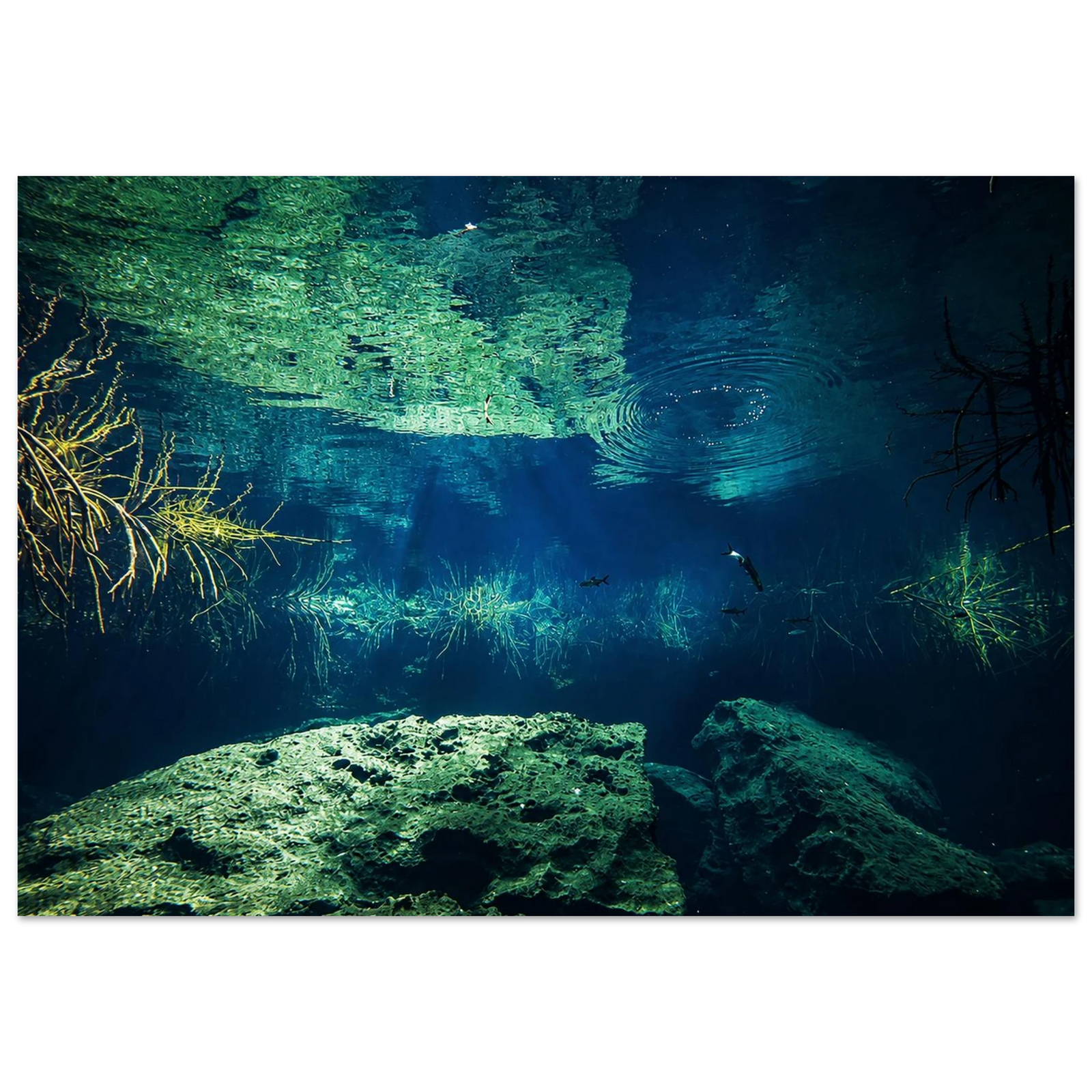
This image is a useful example of how implied movement can create calm. The subject is a brief natural event, but the composition is focused on the expanding rings of water. It can work in a hallway, entryway, home office, bathroom, or wellness setting where the artwork benefits from a sense of motion without visual noise.
The print features a 3mm Aluminum DIBOND® panel with a black polyethylene core, direct printing, and a matte, glare-free surface. A hanging kit is included.
Why matte aluminum works in low-light rooms
Reflective artwork can be difficult to place. A glossy surface may catch a window, ceiling light, bedside lamp, or wall sconce and create a distracting hotspot.
A matte aluminum finish is more practical for many interiors because it reduces glare while preserving crisp photographic detail. It is especially useful when:
- The artwork faces a window.
- A wall is lit by a picture light or wall washer.
- The room includes several lamps.
- The print is placed in a bathroom or humid environment.
- The piece will be viewed from multiple angles, such as in a hotel or office.
Moss Fine Art aluminum panels are direct-printed with a matte, glare-free finish and are designed to resist UV exposure and moisture. The material gives underwater photography prints a clean, contemporary profile without requiring a traditional glass frame.
Size and placement recommendations
The available product sizes make these prints suitable for both small accents and larger statement pieces. Use the room and viewing distance as your guide.
- Bathrooms: Choose a smaller vertical or horizontal format above a towel rail, open shelf, or freestanding tub. Keep the artwork away from direct water spray.
- Bedrooms: Place one larger print above the bed or on a side wall. Images with open water, soft color, or simple texture are usually the most restful.
- Home offices: Use a medium or large piece behind a desk or on a side wall. Texture-based imagery can add interest without distracting from work.
- Hotels and wellness spaces: Consider repeated sizes or a coordinated series across guest rooms, corridors, treatment rooms, and relaxation areas.
- Living rooms: A larger horizontal piece can anchor a sofa or console. Allow enough surrounding wall space for the image to breathe.
These prints are available in 20x30 cm / 8x12 inches, 40x60 cm / 16x24 inches, 60x90 cm / 24x36 inches, and 70x100 cm / 28x40 inches.
Hang the center of the artwork at a comfortable viewing height, and use indirect lighting rather than a harsh spotlight. In a darker room, the goal is to reveal the image gradually, not flatten it with excessive brightness.
Add color when the room needs a focal point
School of Fish Underwater Aluminum Print – Vibrant Costa Rica Marine Photography by Robert Moss was captured while I was scuba diving off Costa Rica. It features a brilliant blue palette and a school of fish in motion.
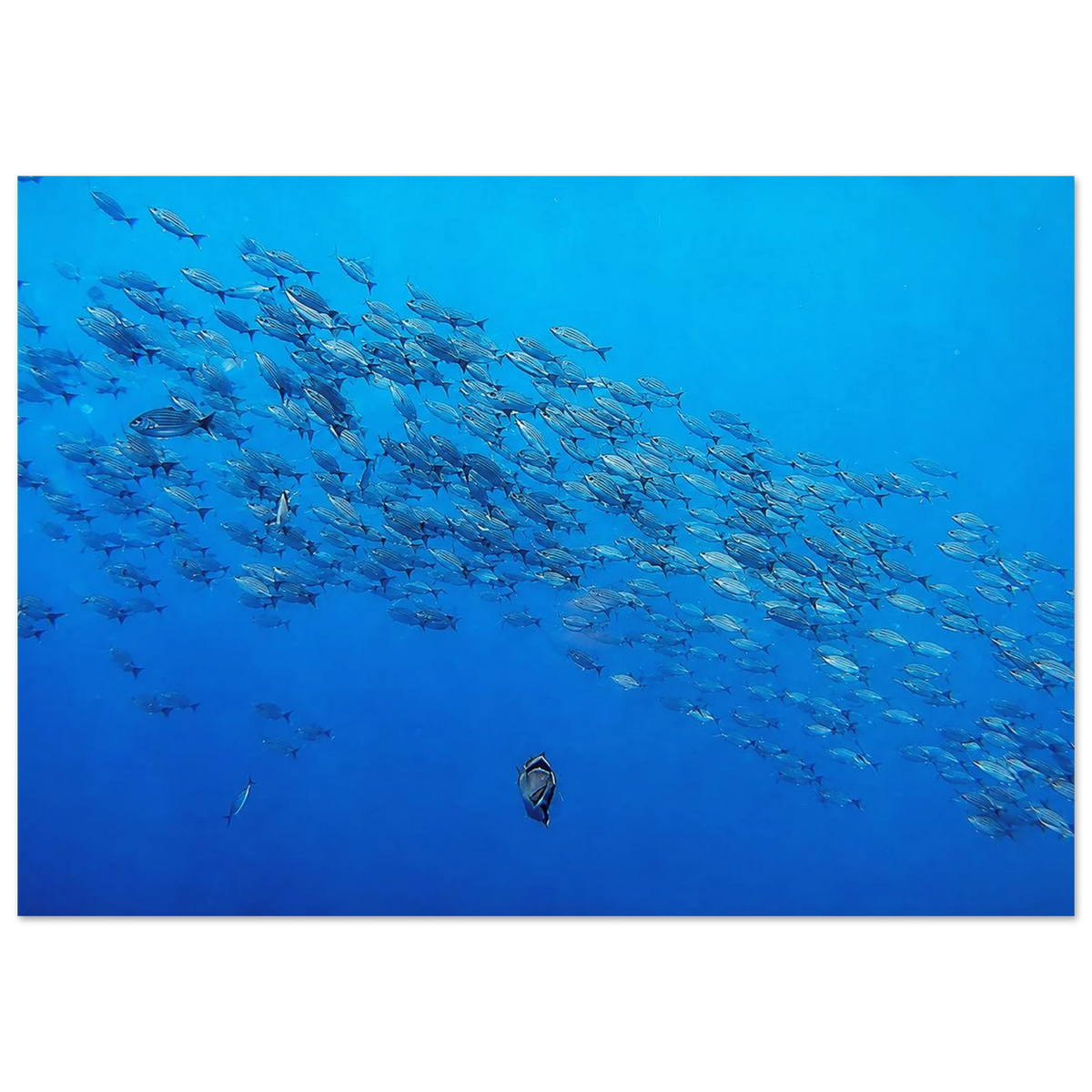
This is the most energetic option in this group. It suits a modern living room, creative office, hospitality setting, or coastal interior that needs a stronger focal point. Use it with white, charcoal, natural wood, or restrained blue accents so the brilliant blue remains intentional.
It is printed directly on 3mm Aluminum DIBOND® with a matte, glare-free finish. The panel is UV- and moisture-resistant and includes a hanging kit.
Conservation-minded ocean photography prints
Several Moss Fine Art ocean pieces support ocean conservation and mangrove restoration work. 10% of profits are donated quarterly to conservation partners. That means the artwork is not only a visual decision for your home, office, hotel, or wellness space. It is also a way to support the ecosystems represented in the photographs.
Explore the full Moss Fine Art photo collection to compare underwater photography prints, ocean photography prints, wildlife photography, and landscape work.
About Robert Moss
For me, nature photography begins with respect. I believe the best wildlife photographs come from observing rather than interfering: by allowing an animal, landscape, or moment to exist naturally and being patient enough to capture it as it unfolds.
My goal is not simply to photograph wildlife, but to create images that convey the character, beauty, scale, and vulnerability of the natural world. From wildlife encounters to remote landscapes and underwater environments, I am drawn to moments that remind us how extraordinary the wild still is.
I approach each photograph with the intention of keeping the scene authentic, preserving the natural behavior of the subject and the atmosphere of the place. That philosophy carries through to Moss Apparel and Moss Fine Art. The photographs are not only meant to be seen; they are intended to create a greater connection with the places and species they represent.
Through Moss Apparel and Moss Fine Art, 10% of profits support nonprofit organizations working in wildlife conservation, habitat protection, and ocean restoration.


